

Description
Cocoa Butter — Rich Natural Butter for Protective Balms, Body Butters, Creams & Nourishing Formulations
Cocoa Butter, also known as Cacao Butter, is a rich natural vegetable butter obtained from cocoa beans during the processing of cocoa solids and cocoa liquor. It is one of the most loved butters in cosmetic formulation because of its firm structure, creamy skin feel, protective emollience, and naturally warm cocoa aroma.
This butter is especially useful when formulators want to create products with body, structure, richness, and a more protective skin feel. It works beautifully in body butters, balms, lip care, lotion bars, soaps, hair butters, massage melts, salves, and rich creams.
Cocoa Butter is naturally firm at room temperature and melts on contact with warmth, making it an excellent ingredient for solid and semi-solid formulations. Its natural antioxidant content also makes it one of the more stable cosmetic butters, giving formulators a beautiful balance of richness, performance, and shelf-life support.
At Skin Foodie, Cocoa Butter is positioned as a premium natural butter for formulators creating rich, protective, nourishing, and sensorially luxurious skincare, haircare, and body care products.
Technical Specifications
INCI: Theobroma Cacao Seed Butter
Common Name: Cocoa Butter / Cacao Butter
Ingredient Type: Natural cosmetic butter / vegetable fat
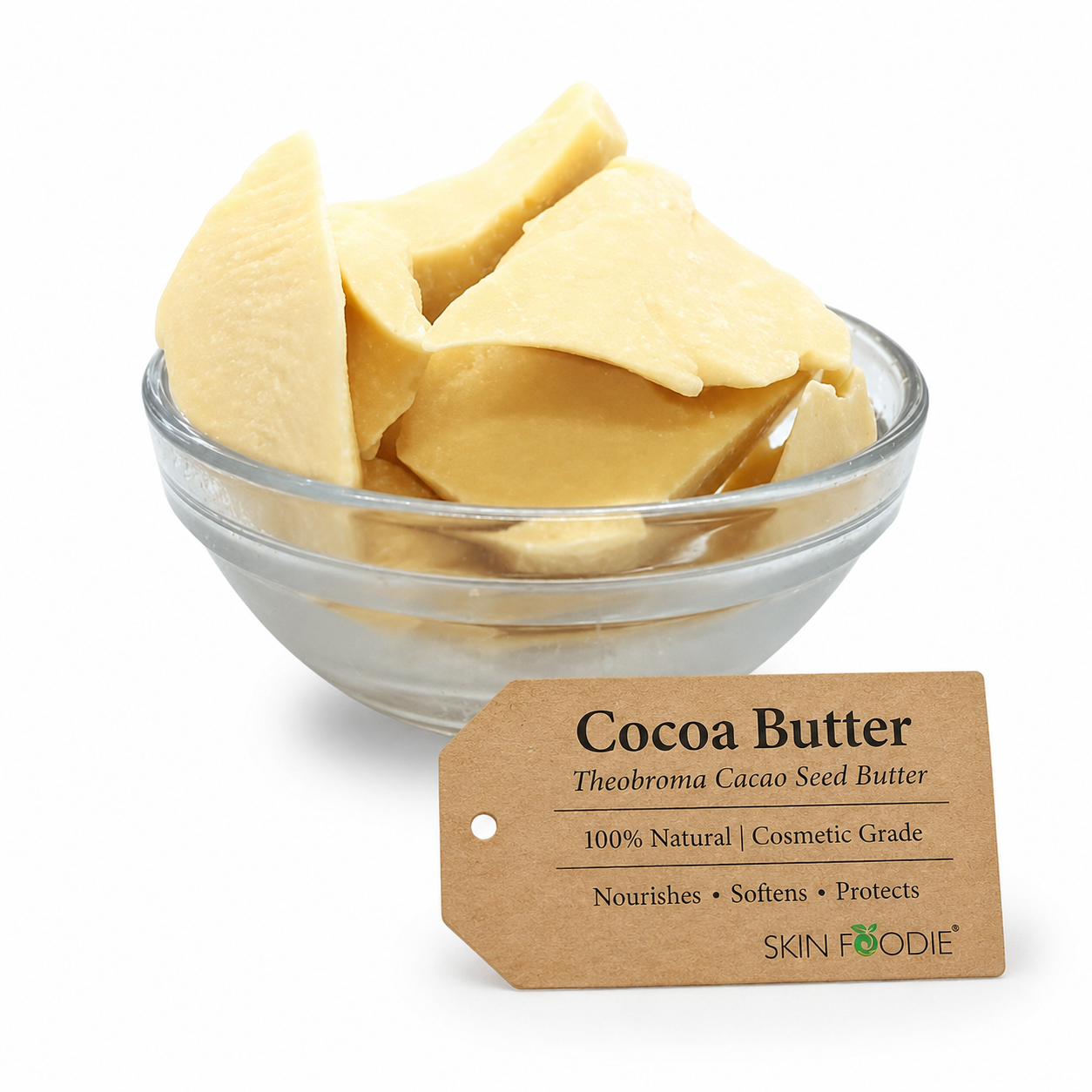
Appearance: Hard beige to light brown butter
Aroma: Natural cocoa aroma; may range from mild cocoa to stronger bitter-chocolate notes
Texture: Firm, hard butter
Melting Behaviour: Melts with gentle heat and skin warmth
Solubility: Oil-soluble
Recommended Usage: 2–90%
Processing Note: Natural/crude butter; colour and aroma may vary from batch to batch
Suitable For: Creams, lotions, balms, lotion bars, lip balms, body butters, soaps, hair products, makeup foundations, salves, massage melts, and anhydrous formulations
Why Formulators Love Cocoa Butter
Rich Protective Emollience
Cocoa Butter creates a soft, protective film on the skin, making it excellent for dry-skin products, balms, body butters, and barrier-style formulations.
Excellent Structure Builder
Because Cocoa Butter is firm at room temperature, it helps give body, hardness, and structure to solid and semi-solid formulations like lotion bars, lip balms, massage melts, and salves.
Naturally Stable Butter
Cocoa Butter is one of the more stable natural fats, making it valuable in formulations where formulators want richness without using a highly delicate oil.
Beautiful Cocoa Aroma
Its natural cocoa scent adds a warm, comforting, chocolate-like sensory profile, especially in body butters, balms, soap, and spa-style products.
Luxury Skin Feel
Cocoa Butter brings a rich, creamy, cushiony skin feel that instantly makes a formulation feel more indulgent and premium.
Common Uses in Cosmetic Formulation
Cocoa Butter is widely used in:
• Body butters
• Whipped butters
• Lotion bars
• Lip balms
• Lip butters
• Body balms
• Salves
• Massage melts
• Anhydrous body creams
• Rich emulsified creams
• Protective hand creams
• Foot balms
• Hair butters
• Hair masks
• Soap bars
• Makeup foundations
• Cream-based colour cosmetics
• Stretch-mark-style body care products
• Dry-skin body care products
Benefits
Skin Benefits
• Nourishes dry and rough-feeling skin
• Helps soften and smooth the skin
• Supports a protective, moisturised skin feel
• Helps reduce the appearance of dryness and flakiness
• Ideal for rich body care and dry-skin formulations
• Leaves skin feeling cushioned and conditioned
• Excellent for lips, elbows, knees, heels, and very dry areas
Hair Benefits
• Helps condition dry-feeling hair
• Adds richness to hair butters and masks
• Supports softness and manageability in textured-hair formulas
• Helps give hair products a more nourishing, protective feel
• Useful in scalp and strand-care butter blends
Formulation Benefits
• Adds firmness and structure to balms and bars
• Improves richness and cushion in creams and butters
• Enhances protective skin feel
• Works well in anhydrous and emulsified products
• Suitable for soap making
• Naturally stable compared with many delicate botanical oils
• Helps create premium, indulgent textures
Important Formulation Notes
Cocoa Butter is firm and should be melted gently before incorporation.
• Melt at low heat, preferably using a bain-marie
• Avoid overheating, as excessive heat can affect its natural aroma
• Stir gently while melting
• Use as soon as it is melted to preserve quality
• In creams and lotions, add to the heated oil phase
• In balms and body butters, combine with softer butters or oils to prevent brittleness
• Test carefully in whipped products, as Cocoa Butter can become grainy if cooled too slowly or exposed to temperature fluctuations
• Always run small-batch testing before scaling
Pro Tips
• Use 2–5% in creams and lotions for added richness and cushion
• Use 5–20% in body butters for a firmer, more protective texture
• Use 10–30% in balms, salves, and lip care for structure and occlusivity
• Use 20–90% in lotion bars, massage melts, and solid butter systems
• Pair with softer butters to reduce brittleness
• Pair with liquid oils to improve spreadability
• Add Vitamin E to support oil-phase antioxidant protection
• For a lighter body butter, balance Cocoa Butter with fast-spreading esters or lighter oils
• For richer dry-skin products, combine with waxes and heavier emollients
For enhanced performance, combine with:
• Mango Butter — softer, creamier body butter texture
• Shea Butter — rich dry-skin nourishment and cushion
• Cupuacu Butter — enhanced moisture-retention story and elegant creaminess
• Sweet Almond Oil — improved glide and softening body-care feel
• Sunflower Oil — lighter linoleic-rich body and baby-care positioning
• Castor Oil — glossy lip balm and balm-stick payoff
• C12-15 Alkyl Benzoate — lighter, less greasy finish in rich body products
• Beeswax — stronger balm, salve, and lip-care structure
• Candelilla Wax — vegan-style firmness and gloss in solid products
• Vitamin E — antioxidant support for oil-based systems
Formulation Pairing — Multiple Intelligent Pathways
Rich Body Butter System
Cocoa Butter + Shea Butter + Sweet Almond Oil
→ Rich dry-skin nourishment + creamy spread + protective body-care feel
Luxury Whipped Butter System
Cocoa Butter + Mango Butter + C12-15 Alkyl Benzoate
→ Fluffy butter texture + improved slip + less greasy finish
Protective Lip Balm System
Cocoa Butter + Beeswax + Castor Oil
→ Firm balm structure + cushion + glossy lip-conditioning feel
Moisture-Retention Butter Blend
Cocoa Butter + Cupuacu Butter + Sunflower Oil
→ Rich butter base + moisture-support + balanced body-care texture
Solid Lotion Bar System
Cocoa Butter + Candelilla Wax + Sweet Almond Oil
→ Firm bar structure + glide + protective moisturising
Hair Butter System
Cocoa Butter + Mango Butter + Avocado Oil
→ Rich conditioning butter + softness + nourishment for dry-feeling hair
Ingredient Comparisons & Alternatives
Cocoa Butter vs Shea Butter
Cocoa Butter is firmer, more structured, and has a natural cocoa aroma. Shea Butter is softer, creamier, and more flexible in whipped butters and creams. Use Cocoa Butter when you want firmness and structure; use Shea Butter when you want a richer, creamier skin feel.
Cocoa Butter vs Mango Butter
Mango Butter is lighter, softer, and less aromatic than Cocoa Butter. Cocoa Butter gives stronger structure and a more protective feel, while Mango Butter creates smoother, more elegant body butters and creams.
Cocoa Butter vs Cupuacu Butter
Cupuacu Butter has a more elastic, creamy texture and is often used for moisture-retention positioning. Cocoa Butter is firmer, more classic, more aromatic, and better for solid products, balms, and chocolate-scented body care.
Cocoa Butter vs Kokum Butter
Kokum Butter is hard and brittle but less greasy and usually more neutral in scent. Cocoa Butter gives more aroma, richness, and classic body-care appeal. Kokum is excellent for elegant firmness; Cocoa Butter is better for indulgent, protective richness.
Cocoa Butter Pairs Well With
Cocoa Butter works beautifully with:
• Shea Butter
• Mango Butter
• Cupuacu Butter
• Murumuru Butter
• Kokum Butter
• Sweet Almond Oil
• Sunflower Oil
• Avocado Oil
• Castor Oil
• Argan Oil
• C12-15 Alkyl Benzoate
• Beeswax
• Candelilla Wax
• Carnauba Wax
• Vitamin E
• Olivem 1000
• Vegetal / Montanov 68
• BTMS 50
• Arrowroot Powder
• Fragrance Oils
• Essential Oils
Formulation Inspiration
Chocolate Silk Body Butter Balm
Cocoa Butter — 28%
Shea Butter — 20%
Mango Butter — 15%
Sweet Almond Oil — 18%
C12-15 Alkyl Benzoate — 10%
Beeswax — 5%
Arrowroot Powder — 2%
Vitamin E — 1%
Milk Chocolate Fragrance Oil — 1%
FAQs
1. What is Cocoa Butter used for in cosmetic formulation?
Cocoa Butter is used to add richness, firmness, structure, emollience, and protective skin feel to body butters, balms, lip balms, lotion bars, creams, soaps, hair products, and solid formulations.
2. Is Cocoa Butter good for dry skin formulations?
Yes. Cocoa Butter is excellent for dry-skin body care because it helps soften, nourish, and protect the skin while adding a rich moisturising feel.
3. Can Cocoa Butter be used directly on skin?
Yes, Cocoa Butter can be used directly on the skin, but it is often easier and more elegant to use when blended into a properly formulated butter, balm, cream, or lotion.
4. Why is Cocoa Butter so hard?
Cocoa Butter is naturally high in saturated fats, which gives it a firm texture at room temperature. This makes it excellent for structure-building in balms, bars, and solid products.
5. Can Cocoa Butter be used in creams and lotions?
Yes. Cocoa Butter can be used in creams and lotions, usually in the heated oil phase. Lower levels are best for emulsions so the product does not become too heavy or draggy.
6. Why does Cocoa Butter sometimes become grainy?
Graininess can occur when butters are overheated, cooled too slowly, or exposed to repeated melting and cooling cycles. To reduce graininess, melt gently, avoid prolonged heating, and cool the finished product quickly and evenly. Repeated temperature fluctuations may also contribute to grain formation.
7. Can Cocoa Butter be used in soap making?
Yes. Cocoa Butter is commonly used in soap bars to add hardness, creaminess, and a more luxurious skin feel.
Shelf Life & Storage
Store tightly sealed in a cool, dry place away from direct sunlight, heat, and moisture.
Cocoa Butter is naturally stable, but good storage helps preserve its aroma, texture, and quality. Avoid repeated melting and cooling, as this may contribute to graininess or texture changes.
The Skin Foodie Formulation Standard
At Skin Foodie, we believe exceptional skincare begins with exceptional ingredients and thoughtful formulation design. Our ingredients are carefully sourced to help formulators create products that are effective, stable, and beautifully balanced.
Because in cosmetic science, selecting the right ingredient is only the beginning, how ingredients are combined is what transforms a formula into a high-performance product.
Disclaimer
For cosmetic formulation use only. Not intended for ingestion or internal use.
Because many naturally derived butters may vary slightly in colour, aroma, or texture from batch to batch, natural variation may occur without affecting product performance.
All formulators are responsible for conducting proper research, compatibility testing, stability testing, and safety assessment when developing cosmetic products.
The information provided on this page is for educational purposes only and should not be interpreted as medical advice.

Nseobong Tommy (verified owner) –
Chisanyim (verified owner) –
Smells like heaven and chocolate
chidi (verified owner) –
Stella (verified owner) –
Rashidat (verified owner) –
NNENNA ANTHONIA (verified owner) –
Anonymous (verified owner) –
Anonymous (verified owner) –
Not like the picture on the wedsite but it’s unrefined
Ify (verified owner) –
Des Y. (verified owner) –